Showing posts with label Clay. Show all posts

Tuesday, June 11, 2019

Cultural Artifacts & Clay Techniques


Who doesn’t love creating with clay in the art room? Clay is always a fan favorite for any grade level. I particularly enjoyed this unit as it combines basic clay skills with a study of cultural arts from around the globe.

Grade 1 students inquired into the transdisciplinary theme of How the World Works while investigating the central idea; how cultures manipulate the natural world. The students explored three basic clay skills while learning about three different cultural art forms.

The first cultural art form the students learned about was a type of folk art from Oaxaca, Mexico called Oaxacan Animals. The students observed and discussed a variety of Oaxacan Animals and their bright patterns to design a turtle in their sketchbooks. The clay skill they began exploring to create their Oaxacan inspired turtles was the pinch pot.  


The next culture we began exploring was from our host country of China. Grade 1 students looked at a variety of Ming Dynasty ceramic vessels. We compared shapes, styles, decorative patterns, and discussed the blue and white colors used in these types of designs. The clay skill the students used to create their own ceramic vessel inspired by Chinese pottery was coiling. Using a variety of coiling techniques, they created some very beautiful coil pots!


The last cultural art form the students investigated was African Masks. They looked at a variety of masks from different tribes in Africa, comparing shapes, patterns, and color. The students chose shapes and patterns that they liked to design their own African inspired mask in their sketchbooks. The clay skill Grade 1 students practiced when creating their mask was rolling and cutting slabs of clay. Some students even poked holes in their wet clay to ensure that they could add hair or jewelry to their final piece once it was out of the kiln!  


Thursday, June 14, 2018

Designer Toys


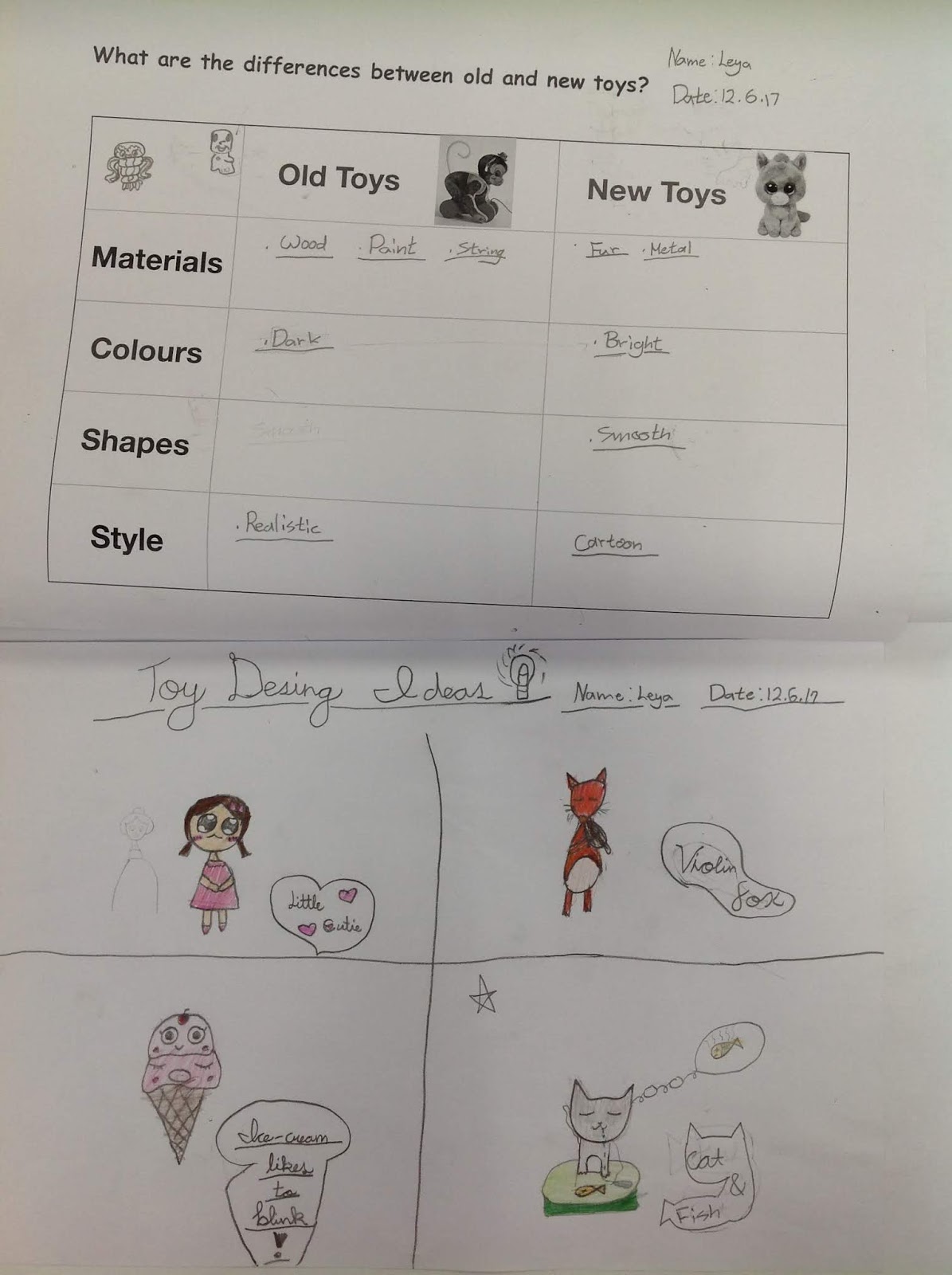
This is one of my (and of course the students!) favorite units of the year. We start off with a provocation where each table in the classroom has a variety of toys that are old and new. The students are to compare and contrast the similarities and differences between all of the toys at their tables. In the end the one thing they all find in common is that all of the toys can move or have moveable parts. They then investigate how toy design has changed over time in order to gather inspiration for their own moveable toy creation. 


 In their sketchbooks, students came up with four different design ideas. They chose their favorite one to develop further by planning out all sides of their final toy including moveable parts and extra materials.


After finishing their design plan, they created a step by step process list of how they would create their toy using their previous knowledge of clay skills. 


The student's final moveable toys are so original and creative, everyone loves the final results! 


Sunday, June 10, 2018

Clay Self Portraits

Grade 4 students created clay self portraits this year while inquiring into the central idea of identity can be expressed in many ways. 

They investigated Guiseppe Arcimboldo's portraits as inspiration for a clay self portrait of their own. They started designing in their sketchbooks first, planning the back and front of their sculpture while combining different elements of who they are as an individual. 


The students used their design as a reference while creating with clay. 

The students then had fun adding layers of glaze as a final touch for these amazing self portraits! 


Sunday, June 3, 2018

Abstract Clay Tiles

This unit was one of my favorite units to teach this year! Grade 2 students investigated abstract art, artists, color, texture, and shape to express an emotion of their choice. Here is was what we inquired into during art classes...

Transdisciplinary Theme: How We Express Ourselves 
Central Idea: Expression can be abstract.  
Lines of Inquiry & Key Concepts: Artists choose certain colors, shapes, and textures to portray different emotions and feelings. (Connection) Audiences have their own point of view and make different connections to colors, shapes, and textures. (Perspective) Artists reflect on their technique and self-management skills to determine when artworks are the best they can be. (Reflection) 
Focus Artists: Wassily Kandinsky and Frank Stella

The students were introduced to this unit through a provocation discussion regarding the difference between Abstract and Realistic art. A range of artworks, examples, and photographs were set up at different tables and students discussed the similarities and differences between the art pieces. This was a great way to get students comparing and contrasting and also to assess students' prior knowledge. At the end of the discussion the students were able to describe the difference between realism and abstraction.

In the next lesson, the students were exposed to a variety of music and painted abstractly using lines, colors, and shapes according to how the music made them feel.
 The students then learned about the Russian artist Wassily Kandinsky and his love of music and art. They enjoyed watching this short video to learn more about his life as an artist and musician. We also read the book "The Noisy Paint Box" by Barb Rosenstock for further inspiration.

The following week, the students explored and discussed art works by contemporary artist Frank Stella. They enjoyed comparing Kandinsky and Stella's work, and used these artists ideas to start organizing their thoughts on how certain lines, shapes, and colors make them feel.
The students then started designing in their sketchbooks an idea for a final clay piece. They focused on an emotion of their choice and the lines, colors, shapes and textures that could reflect that feeling.
Once their ideas were planned, we began creating with clay! The student's created two versions of their abstract clay tile. One was taken home and one was used as a permanent mural installed within the school. Creating two tiles was a great way for reflection and peer feedback throughout the creative process. The students were very impressed and proud of their beautiful abstract work!