Tuesday, June 11, 2019

Artist Trading Cards

Grade 4 students had a blast with this year’s Artist Trading Card unit. They inquired into the central idea of investigation leads to possibilities under the theme of Sharing the Planet.

The students started off the unit by investigating a variety of materials and mixed media to find out which mark making techniques they enjoyed working with. They kept a record of their experiments in their sketchbooks to use as a reference.


As the students continued investigating techniques, they were introduced to Artist Trading Cards or ATC’s. Artist Trading Cards are 2.5 x 3.5 inches and are created for a variety of reasons using multiple layers and different mediums. Most importantly, Artist Trading Cards are meant to be traded.

This year Grade 4 students had an exciting opportunity to trade their cards with a school in Iowa, USA. They were absolutely thrilled to send their cards overseas from China! The students were required to donate one card to send to the United States and donate another card to trade with Grade 4 students at our school. They were able to keep the rest of their collection.

Their next artistic challenge was to create a series of cards based on a specific theme, message, or global issue of their choice. They designed their cards with their message in mind and chose specific materials from their technique investigations.


The students did a fantastic job creating quality Artist Trading Cards with a variety of materials and special messages. They had so much fun trading and receiving cards from a different country and each other. I can’t wait to do this unit again!   


Tuesday, February 26, 2019

Observational Drawing & Artist Studies

Drawing realistically can be a frustrating and challenging task for PYP students. However, observational drawing can be an engaging, fun and useful skill to use and learn from if approached correctly in the classroom.

This unit of inquiry is designed for Grade 2 students but could be easily adapted to fit any grade level. The unit focuses on observational drawing skills, composition, color theory, investigating different drawing materials, and discussing contemporary artists and their work for inspiration. The transdisciplinary theme is under How We Organize Ourselves with the central idea "investigation leads to possibilities."  

At the beginning of the unit we started tuning in by discussing what drawing is and as a class how we felt about it. Many students shared that they thought drawing "the right way" was very hard. In order for all students to feel successful and be accepting of the fact that everyone is at different levels in the artistic process, we watched this beautifully done video called Austin's Butterfly. 


The Grade 2 students really related wonderfully to this video. I paused the clip after each of Austin's draft drawings and the students discussed what could be done better in order to keep trying and "get it right". After numerous discussions during and after the video, the students agreed that they were all capable of improving their drawing skills. As a class it was agreed that they should stay positive and open minded, provide each other with constructive feedback, and keep trying even if they made mistakes. I really emphasized that mistakes are okay, part of the learning process, and that even though they are attempting to capture real life observations, their drawings did not have to be perfect. Perfection was not our goal, only improvement and practicing new skills! 

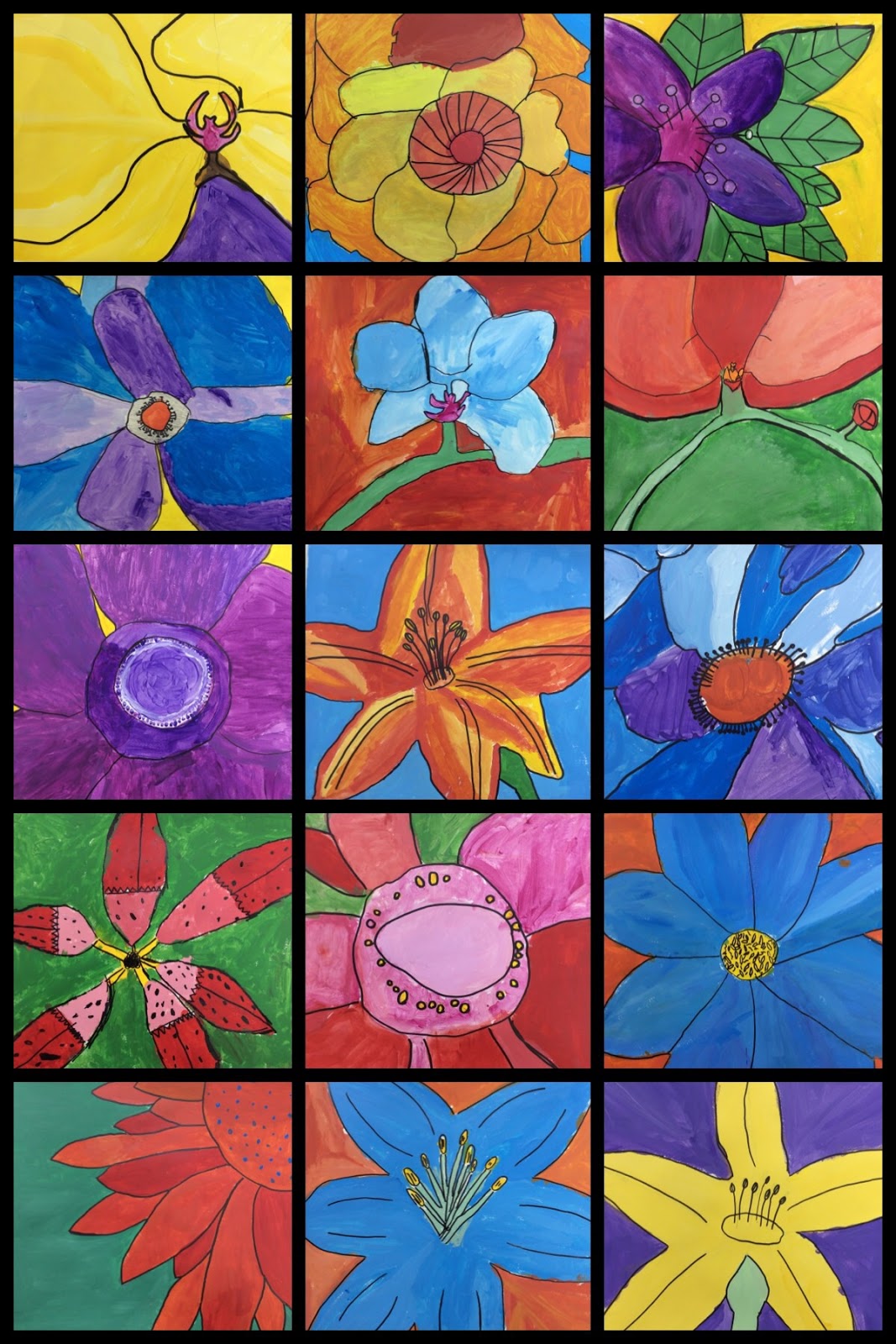
After a lesson of discussion and simple practice drawings, the students started investigating the first focus artist for this unit. Together we watched a short video clip about Georgia O'Keeffe and talked about her famous flower paintings. The students observed that the flowers filled the page and were bright and colorful.

We then began discussing color theory and how colors can impact an artwork. The students learned about complementary and analogous color groupings, filling out the sheet below as a reference for their sketchbooks. 


They then chose a flower from a stack of photographs that they found interesting and began doing practice drawings. The students focused on the outside lines and shapes they could see within their flower, avoiding small and complicated details. The students were encouraged to sketch their flowers large and go off the page.
After practicing color theory and flower drawings in their sketchbooks, Grade 2 students were ready to start their final paintings on large pieces of paper. The students drew their flower first and painted their drawing in by blending analogous colors. They chose the complementary color of their flower to paint the background. Aren't these beautiful!
 *Another version of these beautiful flower paintings can be found on Paint Brush Rocket, which is what inspired the first part of this unit.
 
Once their flower paintings were complete, Grade 2 students began investigating artworks by contemporary artist Anna Valdez through discussions and See, Think, Wonder activities. Together we focused on composition and how to set up a still life using the rule of thirds. 
Grade 2 students then chose 2-4 objects in the art room to set up their very own still life to draw from. Again they were encouraged to draw large and focus on what they observe. When their objects were complete they added a fun background of their choice, inspired by Valdez's constant use of bright patterns within her work. The students used water color pencils and ink pens to complete these amazing still life drawings.


Throughout this unit the students gained creative confidence and remained resilient while experimenting with different drawing materials and improving their observational skills. They loved learning about inspiring artists and realized the many possibilities that observational drawing has to offer. The students are very proud of their final work! 

Wednesday, November 7, 2018

Creating A Positive Classroom Culture

At the beginning of each school year I love getting my classes involved with planning for and creating a personalized positive classroom culture for the rest of the year ahead. I currently teach ten grade 1-5 classes made up of 2 classes per grade level meaning I see roughly 200 students per week. That is a lot of student input on how to make our art room a welcoming, happy, and meaningful place for everyone!


All classes are involved with deciding on essential art room agreements. We do this through think, pair, share sessions and keep track of everyone's ideas on large pieces of paper. These ideas are then grouped into categories so we can choose 4-5 simple "art room promises" for everyone to remember.  After we have decided on which promises we will go ahead with, each grade is responsible for designing something to personalize our special art room for the year. 

Grade 1: Essential Agreements
After taking part in brainstorming and discussing important art promises, grade 1 students jump right in to art room routines in order to practice and remember our agreements while getting used to a new classroom and starting our first unit of the year.

Grade 2: Art Action Wall 
Grade 2 students also begin with their unit right away, participating in a variety of fun activities. One of the activities that fits in well with our abstract art unit is a focus on Kandinsky. The students listen to a variety of music and paint with colors, lines, and shapes based on how the music makes them feel. They do this in small groups on large pieces of paper and this used for our art action wall where we celebrate students taking their knowledge outside of the art room!


Grade 2's finished action wall is a true work of art! I can't wait to see what type of student led action happens outside the art room this year. 


Grade 3: Essential Agreement Display
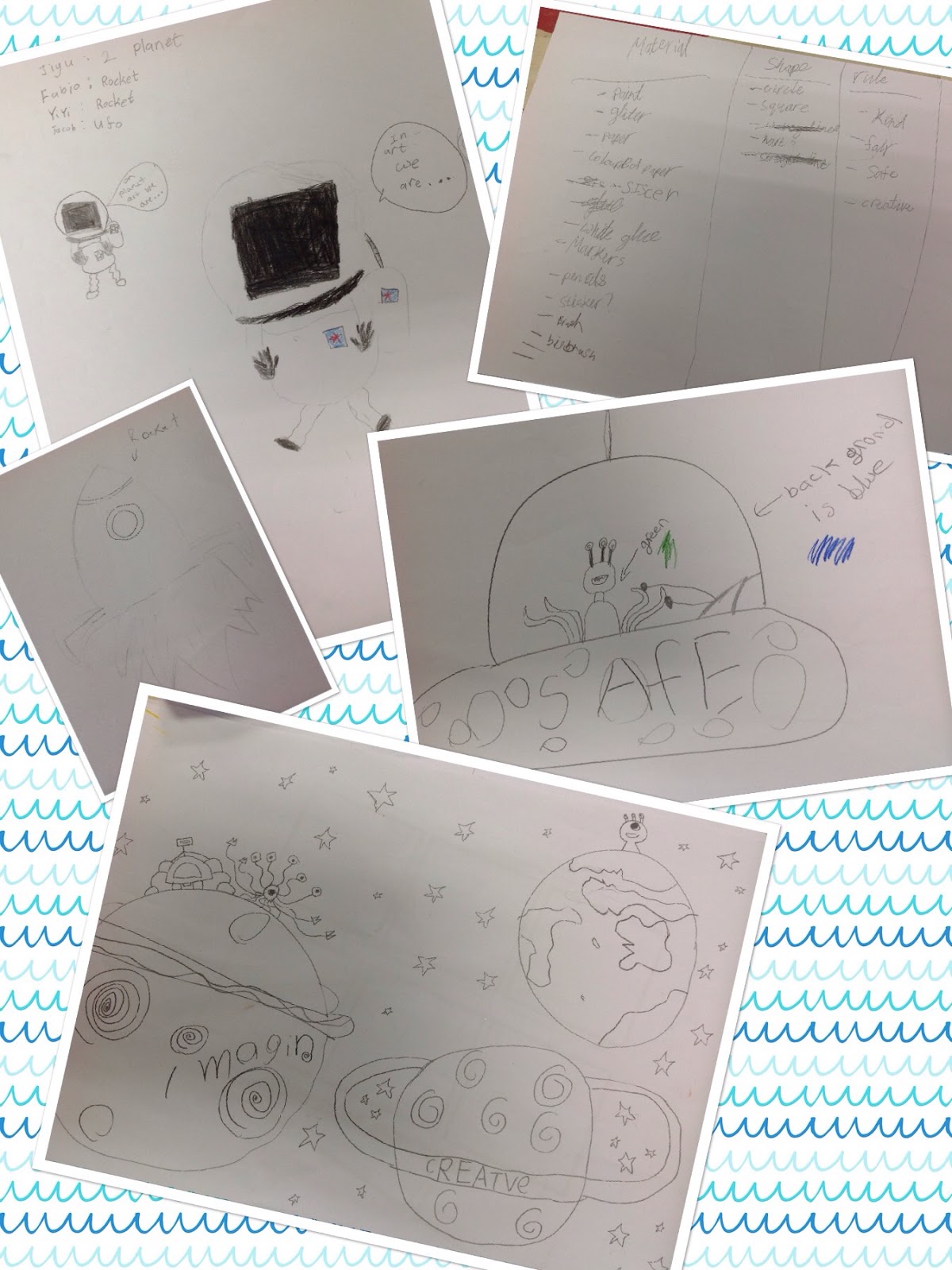
Once our essential agreements have been narrowed down, Grade 3 students are in charge of designing the art room promise display. They all vote on a theme after we do a group brainstorm. Every year it has been something different but I have to say this year is my favorite! Across both of my Grade 3 classes the theme with the most votes was a Galaxy Theme. After the theme was voted on, the students worked in small groups and decided what should be included within the display. After another vote between both classes, they decided on including a rocket, astronaut, planets, stars, comet, and of course a UFO with an alien.

This takes quite a lot of planning on the student's part but the process they go through sets them up well for art lessons the rest of the year! They thoughtfully plan out materials and color choices, they create a design,  they work together, and we have a blast doing it! Isn't their final work incredible?

Grade 4: Learner Profile Posters
Grade 4 students work in small groups and have the challenge of creating a poster that reflects how they will utilize a specific learner profile within the art room. To make things even more fun we take photos with the iPad and use the WordFoto app. Here are some examples of this year's Learner Profile Posters in the art room!


Grade 5: Inquiry Cycle Design 
This is new for me and the students this year, and is very much at the moment still a work in progress! Between working on our first unit, small groups of students are in the process of designing a simple inquiry cycle for each table in the classroom. Some students are drawing and others plan to take photos of each stage within the inquiry cycle.

My students and myself love our art room that we have planned for and created together. It's going to be a great year of art ahead!   

Monday, November 5, 2018

Planning for Authentic Inquiry Learning

Last school year I had the most wonderful opportunity to attend a workshop focusing on transdisciplinary learning for single subject specialists at Concordian International School in Bangkok with my awesome colleague Ms. Kendal (she's a blogger too! check out her blog at http://putting-heart-into-it.strikingly.com/blog)

During this PD we were able to meet with single subject specialists from around the globe including other amazing art teachers. It was such an influential experience and what I was able to take away from that workshop has proved to be invaluable in my professional learning journey as an art educator.

I am currently the visual arts liaison at my school and am very passionate about creating a meaningful program of inquiry that lends itself to student agency, creative problem solving, authentic transdisciplinary connections through conceptual understandings, while using a range of art skills and mediums throughout the year.

After attending the workshop, myself and my colleague worked very hard to improve our program by creating central ideas that are both conceptual and transdisciplinary. We wanted our curriculum to be more accessible to all subjects so that more authentic links could take place throughout the school year and more learning can happen for our students. This is what the current visual arts POI looks like:


Here are the specific improvements that were made to the program over the course of last year:
  • Central ideas are no longer subject specific and can be used across any discipline. 
  • Key concepts are covered at least once every grade level. 
  • Transdisciplinary themes are used once across two grade levels (eg. if they did not cover Sharing the Planet in Grade 1, it will be explored in Grade 2.)
  • Each grade level covers art skills and techniques within the mediums of clay, printmaking, painting, drawing, sculpture, and mixed media.
  •  Each medium covered throughout the year also involves use of technology, a focus on cultural arts, and studying both contemporary and historical artists related to the unit. 
I am very proud of the current program and am so excited to continue building on it's improvements this year with a focus on enhancing and utilizing different forms of assessment, revamping lines of inquiry within individual units, and incorporating a TAB studio approach. I would love to know how other art educators plan for inquiry learning and how their curriculum lends itself to transdisciplinary learning! 

Thursday, June 14, 2018

Rousseau Animals

I am absolutely in love with these Grade 1 paintings! As our last unit of the school year, we focused on art history under the theme of Where We Are in Place and Time by inquiring into the central idea of understanding others inspires us.

The students were introduced to Henri Rousseau by watching a Mati and Dada video about the artist. We also read the book The Fantastic Jungles of Henri Rousseau by Michelle Markel and Amanda Hall.

They then brainstormed about animals they were interested in and chose one for their final artwork. In their sketchbooks, the students listed their chosen animal and the animal's habitat. They thought about the best lines and colors that could represent their animal's habitat in an abstract way in order to plan their background.


The background was then created with oil pastels and water colors based on their sketchbook plan. Their animal was drawn large on a separate paper and filled in with water color as well. I had a lot of scrap painted paper that had been saved through out the year, and this was used to collage extra details into their background like grass, seaweed, or flowers. Myself and the students were so impressed with their final results, I couldn't be a happier art teacher!